
13939063851
13939063851
Ten air-cooled models. The evaporator is cast in one piece and does not rotate, and a stainless knife rolls inside it. First ice in about three minutes, then it runs continuously. Dimensions, weight and power for every model are in the table below.
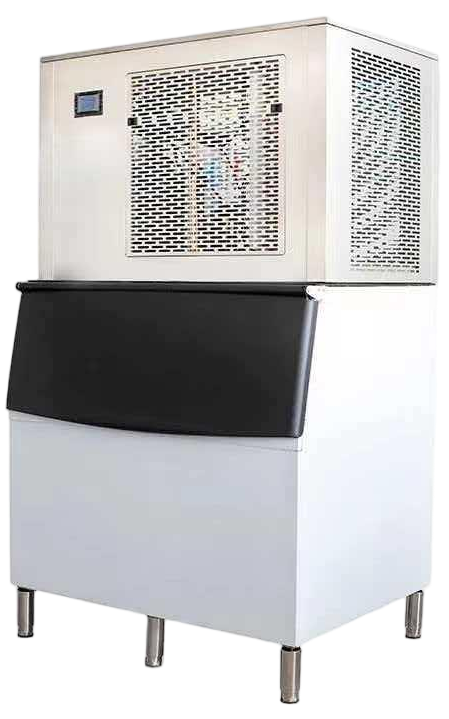

Flake ice is made by freezing a thin layer of water on the inside of a cold barrel and shaving it off. It comes out as thin, dry flakes. It is not crushed cube ice, and it is not snow.
The flakes come out dry, so they do not freeze into one block. Ice that has been in the bin all night still breaks up with the scoop, and nobody has to chip it out with a bar before service.
There are no hard edges to puncture vacuum bags, cling film or box liners, and no sharp points pressing into soft product such as fillets.
Thin flat flakes sit against the product instead of leaving air gaps, so more ice is touching more surface. That is why a flake ice bed cools faster than a bed of cubes.
Seafood and fish processing are the main users. The same applies to poultry, dough, fresh produce and samples that stay on ice for a full shift.
These six points decide how long the machine runs before it needs a service call, and how much it costs to keep running after that.
The barrel is cast in one piece from low-temperature alloy steel, with the refrigerant channel formed inside it. Fewer welds means fewer joints where a leak can start.
The vertical evaporator is bolted to the frame. Nothing rotates at the refrigerant joint, so there is no shaft seal to wear out. That seal is the usual leak point on drum machines.
The knife is made from one length of seamless SUS304 stainless pipe, not assembled from sections. There are no joints to work loose during a long run.
The knife travels around the inside of the barrel on a rolling movement. That gives low resistance and low power draw, no grinding noise, and no ice powder in the bin.
Ice making, shutdown and fault alarms run through the PLC. When something is wrong the panel shows which part, which covers most of what routine service needs.
From a cold start the first flakes arrive in about three minutes. After that the output is continuous, not one batch at a time.
All ten models are air cooled. Dimensions, net weight and electrical data for each model are in the table below.
On a drum machine the evaporator turns, and the refrigerant joint turns with it. That joint wears every hour the machine runs, and a worn joint means gas loss, warm ice and a service call. On this machine the barrel is fixed and only the knife moves, so the joint has nothing to rub against.
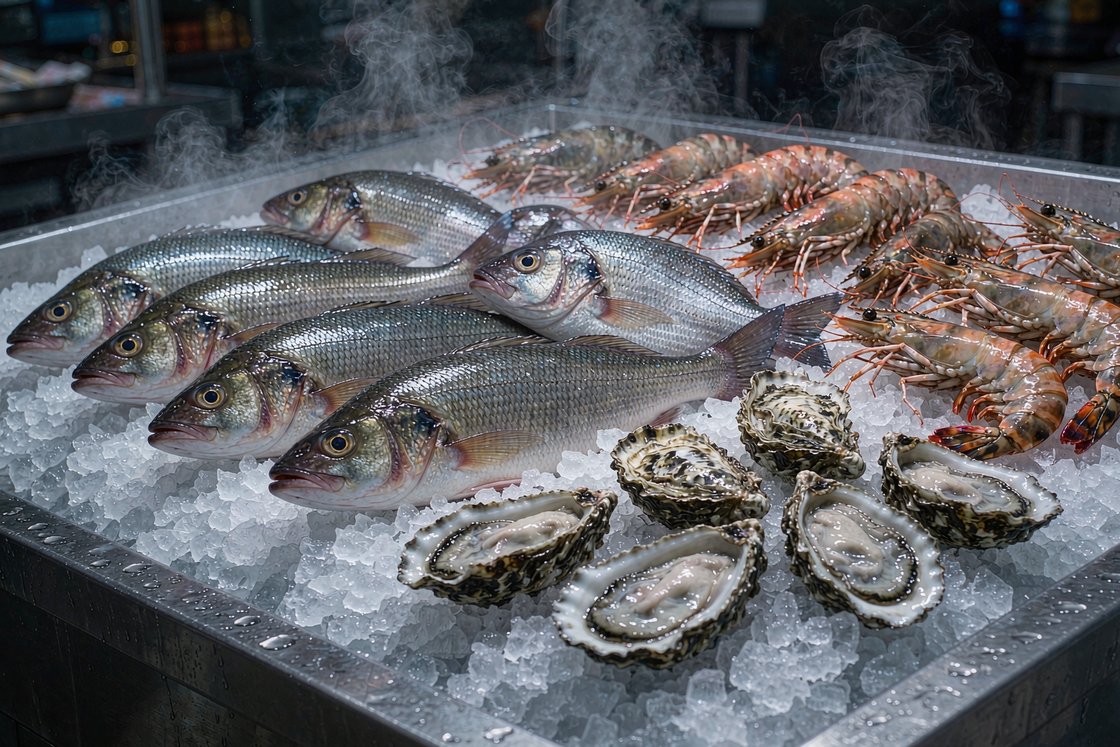
Anywhere product sits on ice for hours, the ice has to stay loose and stay cold. These are the trades that buy this machine most often.
Choose the model by your busiest hour, not by the daily total. Tell us how much ice you use at peak and how much you want held in the bin, and we will name the smallest model that covers it.
All models are air cooled and use R404A. Output is per 24 hours at standard test conditions. Dimensions are the cabinet only, in millimetres.
| Model | Daily output | Ice storage | Cooling | Voltage / current / power | Refrigerant | Net weight | Dimensions (mm) |
|---|---|---|---|---|---|---|---|
| FL-0.2T | 200 kg | 120 kg | Air cooled | 220 V / 5.9 A / 1,290 W | R404A | 133 kg | 560 × 850 × 1,700 |
| FL-0.3T | 300 kg | 200 kg | Air cooled | 220 V / 6.8 A / 1,500 W | R404A | 155 kg | 760 × 850 × 1,780 |
| FL-0.5T | 500 kg | 200 kg | Air cooled | 220 V / 9 A / 1,980 W | R404A | 180 kg | 760 × 850 × 1,880 |
| FL-0.8T | 800 kg | 260 kg | Air cooled | 220 V / 10.5 A / 2,300 W | R404A | 190 kg | 760 × 850 × 1,880 |
| FL-1T3-phase | 1,000 kg | 500 kg | Air cooled | 380 V / 6 A / 3,960 W | R404A | 270 kg | 1,227 × 950 × 1,900 |
| FL-1.2T3-phase | 1,200 kg | 600 kg | Air cooled | 380 V / 6.5 A / 4,200 W | R404A | 292 kg | 1,227 × 950 × 1,900 |
| FL-1.5T3-phase | 1,500 kg | 600 kg | Air cooled | 380 V / 8.2 A / 5,400 W | R404A | 335 kg | 1,227 × 950 × 1,900 |
| FL-2T3-phase | 2,000 kg | 800 kg | Air cooled | 380 V / 9.8 A / 6,500 W | R404A | 350 kg | 1,500 × 970 × 2,260 |
| FL-2.5T3-phase | 2,500 kg | 800 kg | Air cooled | 380 V / 11.2 A / 7,400 W | R404A | 435 kg | 1,500 × 970 × 2,260 |
| FL-3T3-phase | 3,000 kg | 800 kg | Air cooled | 380 V / 14 A / 9,250 W | R404A | 465 kg | 1,500 × 970 × 2,260 |
Output depends on room temperature, water temperature and how well the machine is ventilated. Check your voltage and frequency before ordering: models from 1,000 kg need 380 V three-phase.
The machine arrives almost ready to run. These four items are what usually cause problems on site, so prepare them before the crate is opened.
Models up to 800 kg run on 220 V single phase. From 1,000 kg the range is 380 V three-phase. Give the machine its own breaker, with an isolator within reach.
One dedicated potable water line to the machine. On hard water, fit a softener or cartridge filter before the inlet. Scale on the barrel shows up first as wet, cloudy flakes.
The drain works by gravity. Keep a continuous fall to the floor trap and do not reduce the pipe diameter. A sagging line is the usual cause of water on the floor.
Every model is air cooled. Leave the front and side grilles clear and do not put the machine in a hot corner. A blocked condenser cuts output before it causes a breakdown.
If your question is not here, send it on WhatsApp. Technical questions usually get an answer the same day.
About three minutes from a cold start, then continuous. That matters at opening time, when the bin has been drawn down overnight.
No. The flakes leave the barrel dry, so they stay separate and scoop freely. Ice that has sat in the bin all night still breaks up with the scoop.
The temperature is about the same. The difference is contact: flake ice is soft and covers the product, so more of the surface is touching ice. That is why it cools faster than cubes, and faster than snowflake ice.
Size it by the busiest hour and by the bin, not by the daily total. Send us the kilos you use at peak and the kilos you want in reserve, and we will name the smallest model that covers both.
Potable water to the ice-making inlet. On hard water, fit a softener or cartridge filter: scale builds on the barrel and the first sign is wet, cloudy flakes, long before anything fails.
Both depend on the model and the destination port, so we quote them. Send the model and your nearest port and you get price, lead time and warranty terms in one reply.
即刻联系我们 快速回复